
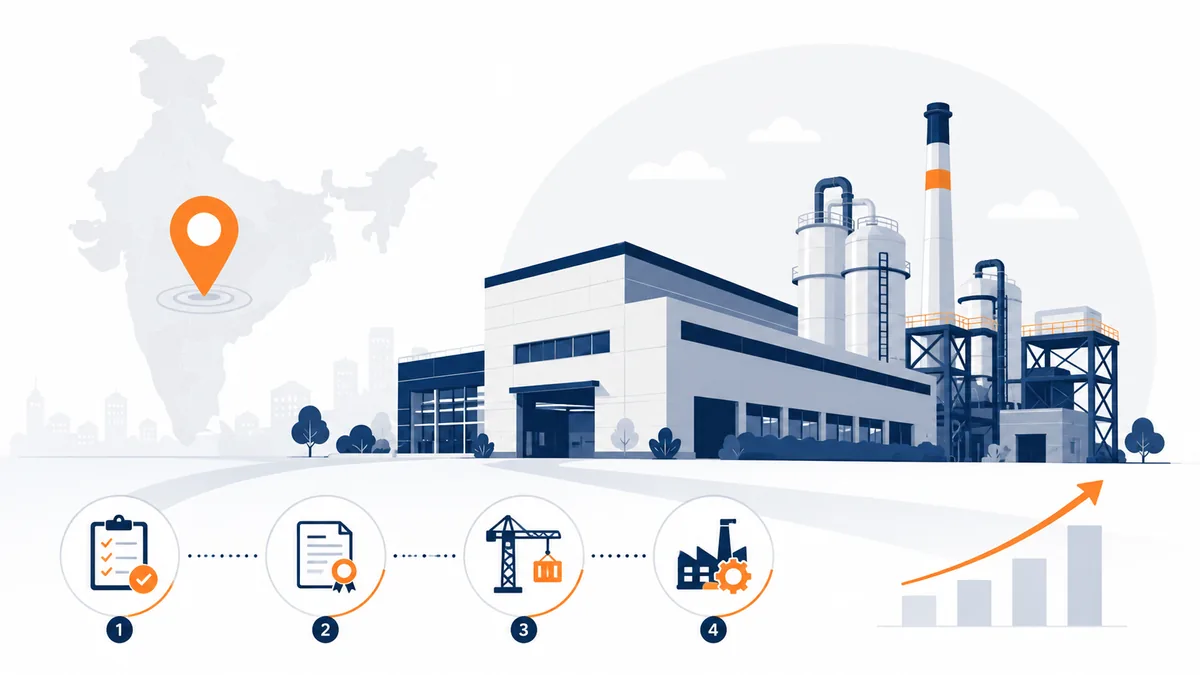
India has become a serious manufacturing destination for global companies seeking scale, a large domestic market and a diversified supply chain. But establishing a plant involves more moving parts than incorporating a company: land, environmental clearances, utilities, labour and a web of statutory approvals all have to align before commissioning.
This guide gives foreign manufacturers a structured roadmap for setting up a factory or plant in India.
Choosing the right location
Site selection drives cost, speed and risk for the life of the plant. Foreign manufacturers weigh proximity to ports and customers, availability and reliability of power and water, labour catchment, and the policy environment of the state.
Many companies prefer industrial parks, SEZs or notified industrial corridors, where land is pre-zoned and core infrastructure is in place, shortening the approval path. Greenfield land acquisition offers more control but takes longer and carries title and land-use considerations.
Legal structure and incorporation
Most foreign manufacturers operate through an Indian subsidiary (typically a private limited company), which can hold the plant, employ staff and contract locally. Foreign investment in manufacturing is generally permitted under the automatic route, though specific activities may carry conditions.
Note: confirm the automatic-route position and any conditions for the specific manufacturing activity — subject to applicable law.
Approvals and clearances
Setting up a plant requires a sequence of approvals across central, state and local authorities. The exact list depends on the product, scale and location, but commonly includes:
- Land use and building-plan approvals.
- Environmental consent to establish and consent to operate from the pollution-control authority.
- Factory licence and registration under applicable factory legislation.
- Fire safety and local municipal clearances.
- Power and water connection sanctions.
- Product-specific licences where the sector is regulated.
Note: confirm the full approval list, sequencing and timelines for the specific state and product — these vary by jurisdiction and are subject to professional review.
Incentives and policy support
Both central and state governments offer incentives to attract manufacturing investment, which may include capital subsidies, support tied to employment or output, and sector-specific schemes. Eligibility and benefit levels vary widely by state and sector.
Note: confirm which incentive schemes apply, current eligibility criteria and benefit levels.
Building the workforce
Plant staffing spans skilled operators, engineers, quality and compliance roles, and management. Foreign manufacturers must align with applicable labour and social-security obligations, factory-shift rules and worker-safety requirements from day one.
Note: confirm applicable labour, working-hours and social-security obligations for the relevant state.
Early workforce planning — including training pipelines and local hiring partnerships — reduces commissioning delays and supports a stable ramp-up.
A phased setup roadmap
- Feasibility and site selection — shortlist states, parks and sites against your cost and logistics model.
- Entity formation — incorporate the Indian subsidiary and set up banking.
- Land and infrastructure — secure land/lease, utilities and connectivity.
- Approvals — environmental, factory, fire, municipal and sector licences.
- Construction and equipment — civil works, plant and machinery installation.
- Trial runs and commissioning — testing, quality validation and ramp-up.
- Operations and compliance — ongoing statutory, environmental and labour compliance.
Our team provides coordinated support across each phase through our factory and plant setup service.
Frequently asked questions
Can a foreign company own a manufacturing plant in India outright? In most manufacturing sectors, full foreign ownership is permitted under the automatic route, though some activities carry conditions.
How long does it take to commission a plant? It varies widely with scale, location and approval complexity — anywhere from several months to over a year for large greenfield projects. Locating in a ready industrial park shortens the timeline.
Are SEZs still worthwhile for manufacturers? They can be, depending on your export profile and the current policy framework. The benefits and conditions are subject to professional review for your specific case.
Talk to our India desk
If you are planning a manufacturing footprint in India, our India desk can help you with site selection, approvals and a phased commissioning roadmap. Book a strategy call to discuss your project.
Disclaimer: general information only, not legal/tax/financial advice. Rules, rates, incentives and thresholds change and are subject to professional review; engage appropriate professionals before acting.
Discuss this topic with our India desk
Get a practical read on how this applies to your company's India plans — in a 30-minute call with a senior advisor.