
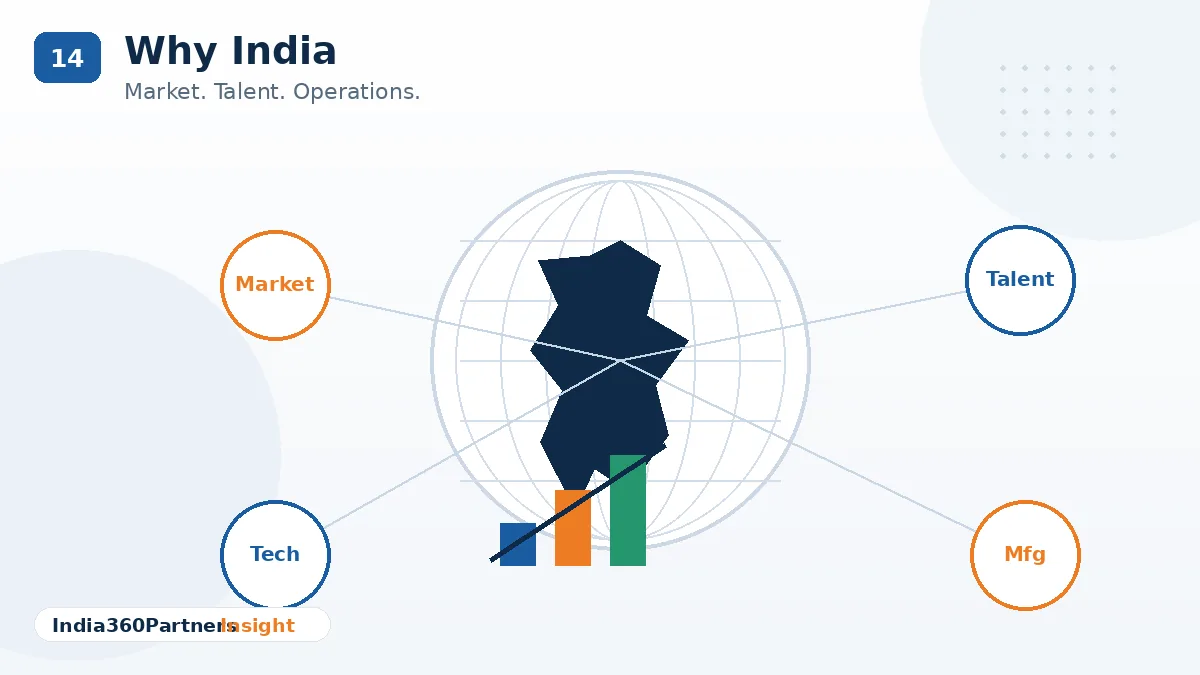
India regularly appears on the expansion shortlist of global companies, and for sound commercial reasons. For a CFO or CEO weighing where to deploy capital and management attention, the case rests less on any single headline and more on a combination of structural factors. This article sets out the drivers and the practical caveats that come with them.
Market scale and a growing consumer base
India is one of the largest consumer markets in the world, with a substantial and expanding middle class. For companies in consumer goods, technology, financial services, and industrials, the addressable market is large enough to justify a dedicated entry strategy rather than opportunistic exports.
A deep, cost-effective talent pool
India produces a large annual cohort of graduates in engineering, technology, finance, and the sciences. This depth supports both back-office and high-value functions — global capability centres, research and development, and product engineering — at competitive cost.
Digital infrastructure and a maturing ecosystem
India’s digital public infrastructure — including widely adopted digital identity and real-time payments rails — has reshaped how businesses reach customers and process transactions. Combined with a vibrant start-up ecosystem, this lowers the cost of acquiring and serving customers at scale.
Policy direction and ease of doing business
Successive reforms have aimed to simplify company formation, streamline taxation through a unified indirect tax, and liberalise foreign investment across many sectors. The direction of travel has been toward making entry and operation more predictable for foreign investors, though the regulatory environment still rewards careful, professional preparation.
The practical caveats
India is attractive, but it is not frictionless. Regulatory compliance is detailed and ongoing, contract enforcement and dispute timelines warrant planning, and state-level variation means a one-size-fits-all approach rarely works. Sector-specific FDI conditions can shape your structure. The companies that succeed treat India as a strategic market deserving local expertise, not a low-effort bolt-on.
A realistic entry plan accounts for these factors from the outset — choosing the right structure, budgeting for compliance, and building or buying local capability through an appropriate professional network.
Frequently asked questions
Is India only relevant for low-cost operations? No. While cost efficiency is real, many companies now use India for high-value functions such as product engineering and research, alongside serving the domestic market.
Do foreign companies need a local partner to enter India? Not generally — many sectors permit 100% foreign ownership under the automatic route. A local partner may be required only where sector conditions specify it.
How quickly can a global business start operating in India? It depends on the chosen structure and documentation readiness. We provide an indicative timeline after reviewing your objectives.
Talk to our India desk
If India is on your expansion shortlist, a focused conversation can sharpen the case for your specific sector and objectives. Book a strategy call and our India desk will help you build a structured roadmap.
Disclaimer: general information only, not advice. Rules, rates, and thresholds change and are subject to applicable law and professional review. Confirm specifics with qualified professionals before acting.
Discuss this topic with our India desk
Get a practical read on how this applies to your company's India plans — in a 30-minute call with a senior advisor.