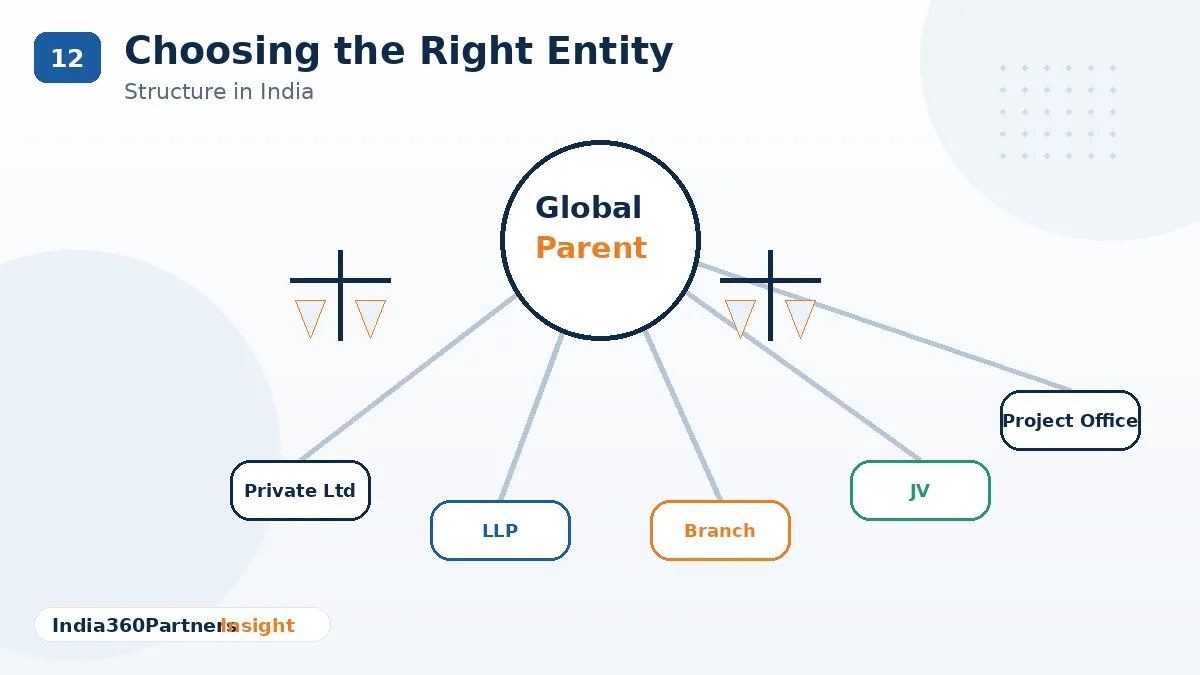

Foreign companies looking at India face an early, consequential decision: how to establish a presence. The route you choose shapes your tax position, your ability to repatriate profits, the scope of activity you are permitted to undertake, and the compliance burden you carry for years afterward. This overview sets out the principal entry options and the trade-offs that usually drive the choice.
Wholly owned subsidiary (private limited company)
For most operating businesses, a private limited company held by the foreign parent is the default starting point. It is a separate legal entity, offers limited liability, and can undertake a broad range of commercial activity. Many sectors permit foreign direct investment up to 100% under the automatic route, meaning no prior government approval is required, though sector-specific caps and conditions apply.
A subsidiary can hire staff, sign customer contracts, raise local financing, and build long-term operations. The trade-off is a fuller compliance calendar — board meetings, annual filings, audit, and tax obligations that we cover in later articles.
Limited Liability Partnership (LLP)
An LLP combines limited liability with a partnership’s operational flexibility. Foreign investment into LLPs is permitted in sectors where 100% FDI is allowed under the automatic route and where there are no performance-linked conditions.
LLPs can be attractive for advisory, consulting, or services businesses that want a lighter governance structure, though some investors prefer the familiarity and fundraising flexibility of a company.
Branch office
A branch office allows a foreign company to conduct specified activities in India — such as export/import of goods, professional or consultancy services, or representing the parent — without forming a separate Indian entity. Branch offices generally require regulatory approval and are subject to conditions on the scope of permitted activity.
Project office
Where a foreign company has secured a contract to execute a specific project in India, a project office can be the appropriate vehicle. It is typically time-bound and tied to the underlying contract, with permitted activity limited to that project.
Liaison (representative) office
A liaison office is a non-trading presence used to explore the market, build relationships, and act as a communication channel between the parent and Indian parties. It cannot earn income in India and is funded by inward remittances from the parent.
This route suits companies that want a foothold to assess demand before committing to a full operating entity.
How to choose
The right structure depends on a handful of questions: Will you earn revenue in India, or only represent the parent? Do you need to hire and contract locally? Is your sector subject to FDI caps or conditions? How important is profit repatriation and future fundraising? And what governance overhead is acceptable?
In practice, operating businesses that intend to sell, hire, and scale most often select a wholly owned subsidiary, while companies testing the market lean toward liaison or branch structures. We help foreign companies map these factors to a recommended structure and a realistic timeline, subject to professional review of the specific facts.
Frequently asked questions
Can a foreign company own 100% of an Indian subsidiary? In many sectors, yes — 100% foreign ownership is permitted under the automatic route. However, certain sectors carry caps or require prior approval.
Is a liaison office allowed to invoice Indian customers? No. A liaison office is a non-trading presence and cannot earn income in India; it is funded by remittances from the parent.
How long does it take to set up a subsidiary? Timelines vary with documentation readiness and approvals. We provide an indicative schedule after reviewing your specific facts.
Talk to our India desk
Choosing an entry route is easier with a structured conversation about your objectives, sector, and timeline. To discuss which option fits your business, book a strategy call with our India desk and we will walk you through a coordinated roadmap.
Disclaimer: general information only, not advice. Rules, rates, and thresholds change and are subject to applicable law and professional review. Confirm specifics with qualified professionals before acting.
Discuss this topic with our India desk
Get a practical read on how this applies to your company's India plans — in a 30-minute call with a senior advisor.