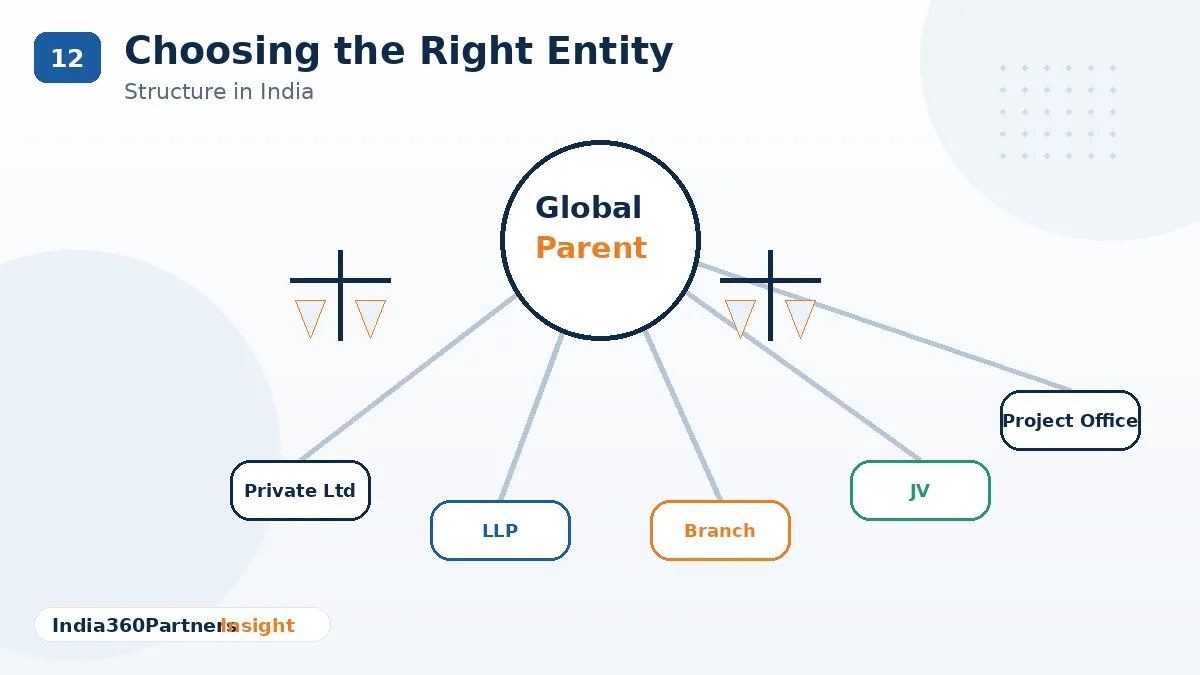
Once a foreign company decides to enter India, the next question is the legal vehicle. The structure you adopt is difficult and costly to change later, so it deserves a deliberate decision grounded in your commercial plan rather than a default copied from another company. This article offers a framework for that decision.
Private limited company
The private limited company is the most common vehicle for operating businesses. It offers limited liability, a familiar corporate governance model, the ability to issue shares to investors, and broad permitted activity. It is generally well suited to companies that will hire, contract, and scale in India.
The trade-off is governance: board meetings, statutory registers, annual filings, and audit.
Limited Liability Partnership (LLP)
An LLP provides limited liability with a lighter, partnership-style governance model and fewer ongoing formalities than a company. Foreign investment into an LLP is permitted where 100% FDI is allowed under the automatic route without performance-linked conditions.
LLPs can suit services and advisory businesses, though companies that expect to raise external equity often prefer the company form.
Branch, project, and liaison offices
These unincorporated structures let a foreign company operate in India without forming a separate entity, but each carries scope restrictions and usually requires regulatory approval. A liaison office cannot earn income; a branch office is limited to specified activities; a project office is tied to a particular contract.
The factors that drive the choice
Five questions usually settle the decision. First, liability — do you need a clean separation between the Indian operation and the parent? Second, activity scope — will you trade and invoice in India, or only represent the parent? Third, repatriation — how will profits or surpluses return to the parent, and with what tax treatment? Fourth, fundraising — will you bring in outside investors? Fifth, compliance appetite — how much governance overhead is acceptable?
Tax and repatriation considerations
Different structures carry different tax and repatriation profiles. Profits of a subsidiary are taxed at the corporate level, with distributions subject to applicable rules; offices and LLPs follow their own treatment. Because cross-border tax interacts with treaties and the parent’s home jurisdiction, this is an area to resolve with qualified tax professionals before committing.
Frequently asked questions
Is a private limited company always the right choice? Not always. It suits most operating businesses, but services firms may prefer an LLP, and companies only representing the parent may use a liaison or branch office. The choice follows the commercial plan.
Can we convert from one structure to another later? Conversions are possible in some cases but can be complex and costly. It is better to choose deliberately at the outset.
How does structure affect profit repatriation? Each structure has a distinct repatriation and tax profile. This should be modelled with tax professionals before incorporation.
Talk to our India desk
The right structure flows from your objectives, sector, and tax position. To map those to a recommended vehicle through a structured roadmap, book a strategy call with our India desk.
Disclaimer: general information only, not advice. Rules, rates, and thresholds change and are subject to applicable law and professional review. Confirm specifics with qualified professionals before acting.
Discuss this topic with our India desk
Get a practical read on how this applies to your company's India plans — in a 30-minute call with a senior advisor.